How much do things
seen in LEED (recycled content, local sourcing, etc.) matter?
Author: Kelly
Roberts; Contributors: Martha VanGeem, John Anderson, Rebecca Jones
LEED 2009
In the current version of LEED, LEED 2009, the two main credits that
structural engineers tend to focus on are the regional and recycled content
material credits. These are also the two
credits in the Materials and Resources category that are overwhelmingly most
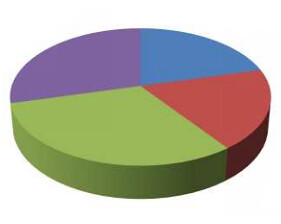
often pursued and won, as demonstrated by the bar graph below. However,
recycled content and regional content in LEED 2009 and previous versions are
single attribute criteria that do not take into account a full life-cycle
assessment (LCA) of materials and can therefore sometimes misrepresent the
actual environmental impact of the project materials.
Figure
1: Breakdown of LEED Materials and resources points awarded (The Institution of
Structural Engineers 2012)
Before looking further into the recycled and regional content credits,
it is important to recognize that there are some credits within LEED 2009 that
do better at considering life-cycle impacts.
MR credit 1, Building Reuse, awards points to project teams that reuse
existing buildings and nonstructural elements.
Although not always recognized as such, this credit may have one of the
largest embodied environmental benefits of all of the material credits. Humbert et al (2007) conclude: “The initial
credits of materials & resources (aiming at reusing the structure of the
building) provide high benefits, whereas the rest have low benefits.” Unfortunately this is one of least pursued
credits within the Materials and Resources category. However, since an actual life-cycle
assessment is not part of LEED 2009, any quantifiable environmental benefits for
each credit are generally unknown to project teams.
Recycled Content
The recycled content credit, MR Credit 4, states, “The recycled content
value of a material assembly is determined by weight. The recycled fraction of
the assembly is then multiplied by the cost of assembly to determine the
recycled content value.” Since the focus of this credit is on cost, project
teams can focus on purchasing big ticket items with high levels of recycled
content in order to achieve the credit.
However, as Scheuer and Keoleian (2013) have noted, this approach does
not accurately reflect the material environmental impact nor ensure the
greatest environmental benefit to the project.
In fact, in many cases, this credit can be achieved by only using
standard construction materials and techniques.
For example, structural steel is a commonly used and highly recycled
material. For many commercial buildings,
both points for this credit can be achieved by considering the recycled content
value of the steel alone since steel is both a high cost (because the high
quantity used) and highly recycled (Scheuer and Keoleian 2013). In addition, some recycled materials, such
as ceramic tile, may have a greater environmental impact than their virgin
counterparts (Scheuer and Keoleian 2013).
In some cases, specifying a certain recycled content coupled with a
failure to appropriately weigh accurate environmental impacts can result in
unintended negative impacts. Anderson
and Silman(2009)
point out that since there are many variables in environmental impacts, proper
metrics and weighting should be used in lieu of simplifications. For example, in the case of specifying high recycled
steel content, the authors point out, “The mature scrap market for steel, a
highly valued material, already results in recycling rates of 85% for the
construction industry. The specification of a minimum recycled content, or
completely recycled materials, causes rerouting of materials that would have
already been recycled, thus creating additional environmental burdens
associated with transportation”.
Regional Content
The regional content credit, MR Credit 5, states, “use building materials or
products that have been extracted, harvested or recovered, as well as
manufactured, within 500 miles of the project site for a minimum 10% or 20%,
based on cost, of the total materials value.
Since this credit is again, based on cost, there are similar
environmental pitfalls with this credit as with the recycled content credit.
The credit can promote a false impression that materials of low mass that have
been chosen due to their proximity to the project site have a smaller
environmental impact which, within the boundaries of a case study by Scheuer
and Keoleian (2013), does not appear to have merit. This credit largely addresses the
transportation portion of the material life cycle. Since building construction requires large
volumes of materials to be delivered to a single project site, the
environmental impact due to transportation and the consumption of fossil fuels
can be significant(Scheuer and Keoleian 2013) . While this credit intends to promote local
economies, since the 500 mile radius can extend over several municipalities,
states and regions, it is questionable whether the credit actually achieves
this goal.
LEED v4
The proposed next version of LEED, LEED v4,
is scheduled for member ballot in the summer of 2013. In its current form, the Materials and
Resources section of LEED v4 will see a major overhaul with several additions
and changes to the credits. As proposed,
the new Materials and Resources section will focus on supporting a life-cycle
approach to material selection, at both the whole-building and the product level. In previous versions of LEED, the Materials
and Resources section focused on single attributes of materials such as
regional sourcing or recycled content.
With this move toward incorporating life-cycle assessments for the whole
building and products, LEED is attempting to take a more holistic approach to
determining the environmental impact of materials and resources.
The first Materials and Resources credit in
the current LEED v4 draft, “MRc1: Building life-cycle impact reduction”, is
intended to “encourage adaptive reuse and optimize the environmental
performance of products and materials” and aims to look at the life-cycle
impact at the whole-building level. This
credit rewards the most points to project teams that are able to reuse or
renovate an existing building with an emphasis on reusing a historic,
abandoned, or blighted building. Points
are also awarded to project teams that perform a whole-building life-cycle
assessment and can demonstrate a 10% reduction across various environmental impact
measures versus a reference building.
The next three credits included in the LEED
v4 Materials and Resources section are different variations of “Building
product disclosure and optimization”.
The first intent of all of these credits is to “encourage the use of
products and materials for which life-cycle information is available and that
have environmentally, economically, and socially preferable life-cycle
impacts”. The first of these credits,
MRc2, focuses on environmental product declarations (EPDs) and aims to
encourage project teams to select products that have a verified EPD.
The next credit, MRc3, targets the sourcing of raw materials and serves
to encourage the use of products that have been extracted or sourced in a
sustainably-focused manner. Finally,
MRc4, is intended to reward teams that select products that have inventoried
ingredients and/or that are known to not be harmful to human health and safety.
LEED v4 has been touted by its supporters
to “paint a more complete picture of materials and products, enabling project
teams to make more informed decisions that will have greater overall benefit
for the environment, human health and our communities, while also encouraging
manufacturers to improve their products through innovation” (Todd 2013). However, the changes have been met with some resistance
from building professionals. Nadav
Malin, a materials and sustainability specialist at Building Green, wrote in
September 2012, “building professionals don't necessarily disagree with the
direction of the new credits, but are wary of changing the system so radically
all at once, and concerned that tools and resources needed to meet the new
credits are not yet available”.
There is no doubt that these proposed
credits will have a significant impact on project teams pursuing LEED
certification; these credits may also impact the role of the structural
engineer during the LEED planning process.
A sixth comment period was scheduled in March 2013 and the ballot is
planned for June 1, 2013.
References
Anderson, J., Silman, R. (2009). “A Life
Cycle Inventory of Structural Engineering Design Strategies for Greenhouse Gas
Reduction,” Structural Engineering International.
Humbert, S., H. Abeck, N. Bali and A.
Horvath. (2007). "Leadership in
Energy and Environmental Design (LEED): A Critical Evaluation by LCA and
Recommendations for Improvement," International Journal of Life Cycle
Assessment, Vol. 12, Special Issue 1, pp. 46-57.
LEED Reference Guide for Green Building
Design and Construction v4 Draft. USGBC.
Malin, Nadav. (2012). “A Material Issue”.
Green Source Magazine.
Scheuer, C.W., Keoleian, G. A. (2013).
Evaluation of LEED Using Life Cycle Assessment Methods, NIST GCR 02-836, 2002.
Todd, Joel Ann. (2012). "Life Cycle
and LEED". EDC Magazine.
The Institution of Structural Engineers.
(2012). “The Value of Structural
Engineering to Sustainable Construction”.